This year, Kitsoft became part of one of the largest international initiatives in the field of digital governance — the GovStack Women in GovTech Challenge 2026. More than 200 participants from 85 countries developed prototypes of real public services over the course of six weeks — and did so using the low-code platform Liquio.
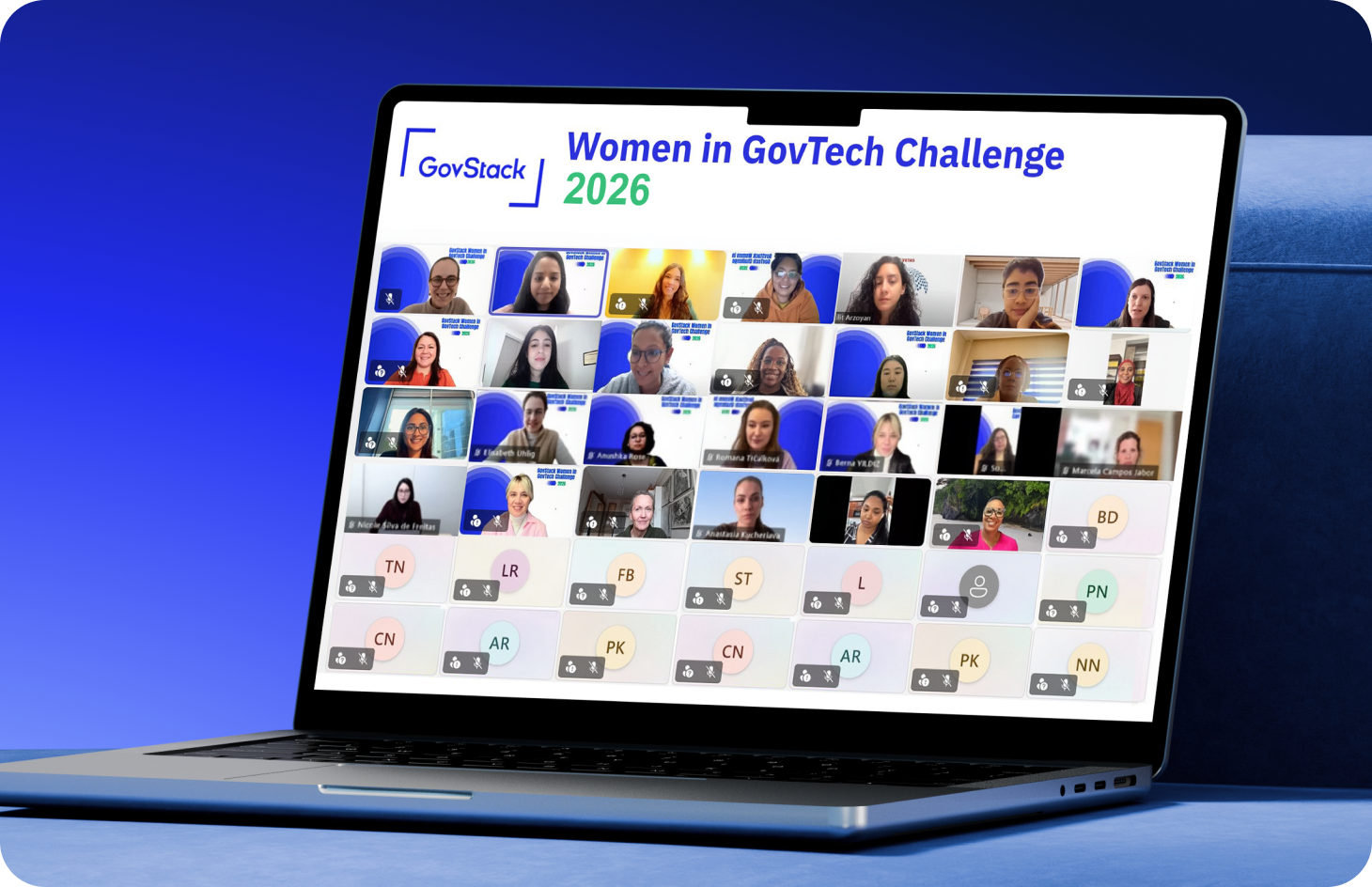
Women in GovTech Challenge is a global initiative by GovStack, implemented in partnership with the World Bank, the United Nations Development Programme (UNDP), the UN Office for Digital and Emerging Technologies (UN ODET), and University College London (UCL). The program brought together women working in digital transformation and gave them the opportunity to create their own GovTech solutions.
The 2026 edition became the third cohort and the largest in scale — with over 1,000 applications, of which 200 participants were selected. Over six intensive weeks, participants not only learned but also worked on real cases: immersing themselves in the principles of Digital Public Infrastructure, mastering the GovStack Building Blocks architecture, and studying GDPR requirements.
Participants worked in international teams and went through the full cycle of service creation — from problem definition and user research to business analysis, process modeling, and prototype development, which were presented to experts at the end of the program.
Participants were supported in working with Liquio and developing digital services by platform tutors from Kitsoft: Helen Uvarenko — Head of International Programs, Liza Stoliarchuk — Delivery Low-code Developer, and Mariia Iefremova — Business Analysis Lead. Support for participants was also provided by low-code specialists Ihor Kucheriavyi and Liubov Shpakova, as well as BA/Support specialists Pavlo Vlashchenko and Yurii Kryvosheia.
“The challenge served as a platform for collaboration among specialists who would not work together, while Liquio enabled them to co-create and prototype real services using a shared, accessible tool tested in practice,”
said Helen Uvarenko, tutor of the Liquio platform in the GovStack Women in GovTech Challenge 2026.
What solutions teams created
Work on services within the program did not begin with ready-made ideas, but with research. 33 teams analyzed real problems in different countries, studied user experience, and then developed solutions that could work in a specific context. After that, participants selected ideas and turned them into prototypes of digital public services.
Among the solutions were services for youth employment, digital academic certificates, birth and death registration, services for maternal health, and platforms for business registration and obtaining licenses.
At the same time, participants took into account not only functionality, but also the real context of use.
"In trying to develop a system that is usable, we have to think of all categories of citizens who should have access to that platform — and then, of course, interoperability: ensuring it interacts with every other government service provided online."
— emphasizes Dr. Ibiso Kingsley-George, an expert in digital policy and public administration in Nigeria and a mentor of the challenge.
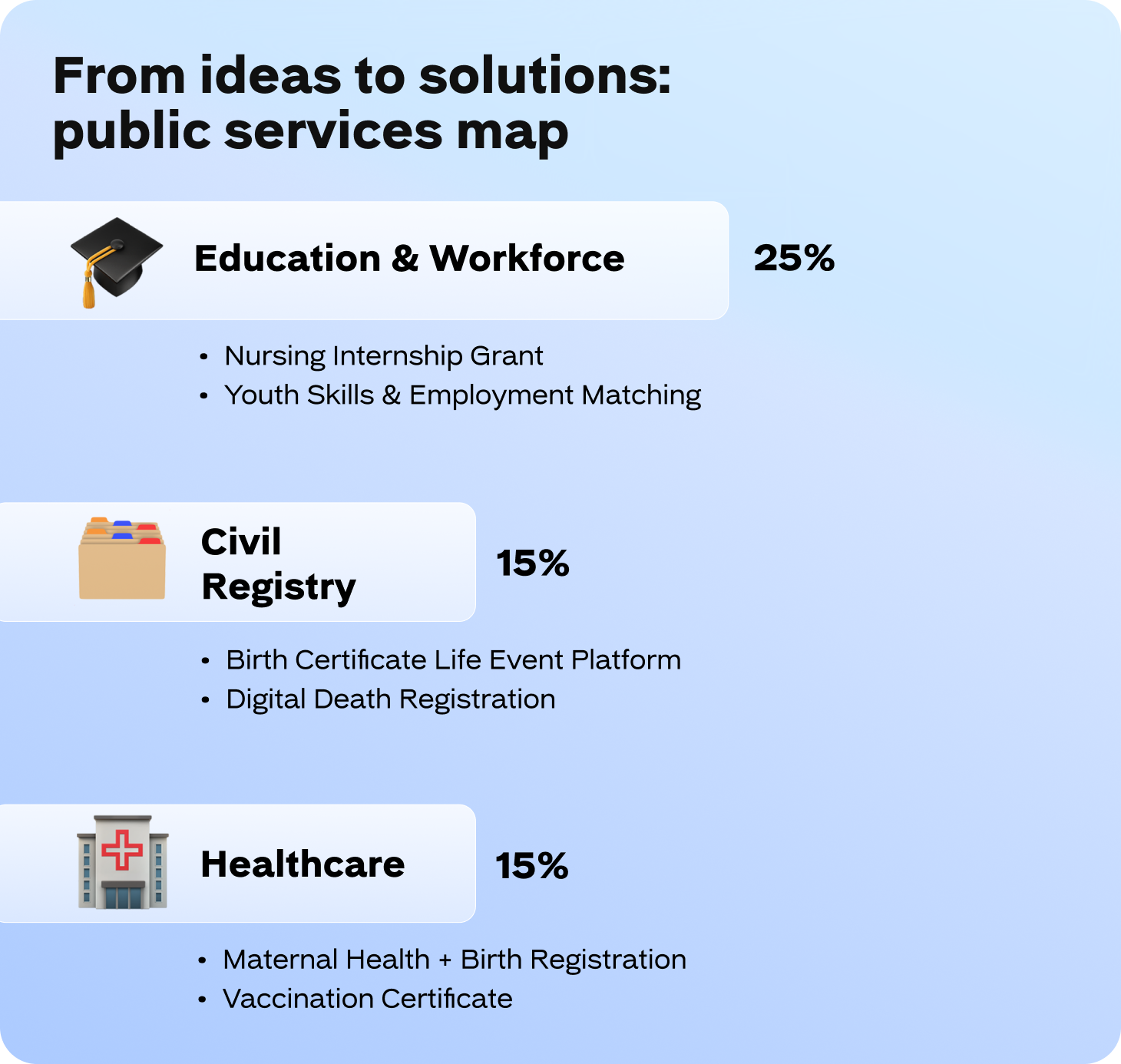
Image: A map of participants’ digital solutions
Most projects were concentrated in the fields of education and the labor market (about 25%). Another 15% each focused on civil registries and healthcare. Teams also worked on services in the areas of social protection and business services (around 10% each). Some teams worked on solutions in mobility, the agricultural sector, and urban infrastructure.
The geography of the projects reflected local needs. Despite different contexts, participants faced similar challenges.
“We might all be from different parts of the world, but the problems are universal. Government agencies still struggle to talk to each other digitally... A simple problem can become complex. Once you start considering policies and how people will adapt, what seemed straightforward becomes a layered challenge.”
— notes Amina Ramallan, digital inclusion advocate focused on empowering women and youth and building a secure and resilient internet ecosystem in Nigeria, mentee in the GovStack Women in GovTech Challenge.
How prototypes were created
Participants of the program created services on the low-code platform Liquio, developed by Kitsoft. This allowed them to quickly move from idea to a working solution, test process logic, work with forms, data, and roles, and make changes without complex development. The low-code approach significantly reduces the time needed to create services and allows teams to focus on content rather than technical constraints.
“The tools that are made available, the technical resources that are given to the women building these prototypes, help ensure that these prototypes are actually impactful. Because the challenge in the real world is that sometimes you find that we can have brilliant ideas, brilliant solutions, and still not have the right kind of tools to create actual digital systems.”
— says Tuntufye Laura Ntaukira, UNDP Malawi, mentor of the GovStack Women in GovTech Challenge.
At the end of the program, teams presented their solutions in short presentations to international experts from GovStack, GIZ, and the World Bank.
“What matters is how clearly the problem is defined, whether it is truly user-centered, how logically its structure is built, and how the GovStack principles are applied. Essentially, what is evaluated is not the concept, but how much the prototype already works as a real service,”
explains Liza Stoliarchuk, Delivery Low-code Developer at Kitsoft and Liquio platform tutor in the GovStack Women in GovTech Challenge 2026.
Prototypes created during the program may later become the foundation for real services, says Oleksandr Iefremov, CEO of Kitsoft:
“If a prototype proves its value by solving a concrete problem, it can serve as the starting point for a production system. With a platform like Liquio, the transition from prototype to real service can be relatively smooth, as the same architecture and components can scale.”
A conversation about how digital services are created
Further insights into the challenges of designing connected public services, as well as lessons learned from real prototypes, are shared in the Code the State podcast, launched by Kitsoft with support from the International Telecommunication Union (ITU).

Image: A podcast about how digital states are actually built
The podcast brings together programme participants, mentors, and international experts to discuss how digital services are built in practice. From early ideas to implementation, and the challenges teams face along the way.
In the Women in GovTech series, speakers share insights from real service projects, offering a behind-the-scenes look at digital transformation across different countries and contexts.
“Women in GovTech Challenge 2026 demonstrates a powerful idea: when people are given the right tools, structure, and conditions, they do not just learn — they create. And when they create, they shape services that have the potential to go beyond the challenge itself,”
emphasized Mariia Iefremova, Business Analysis Lead at Kitsoft and a Liquio platform tutor in the GovStack Women in GovTech Challenge 2026.