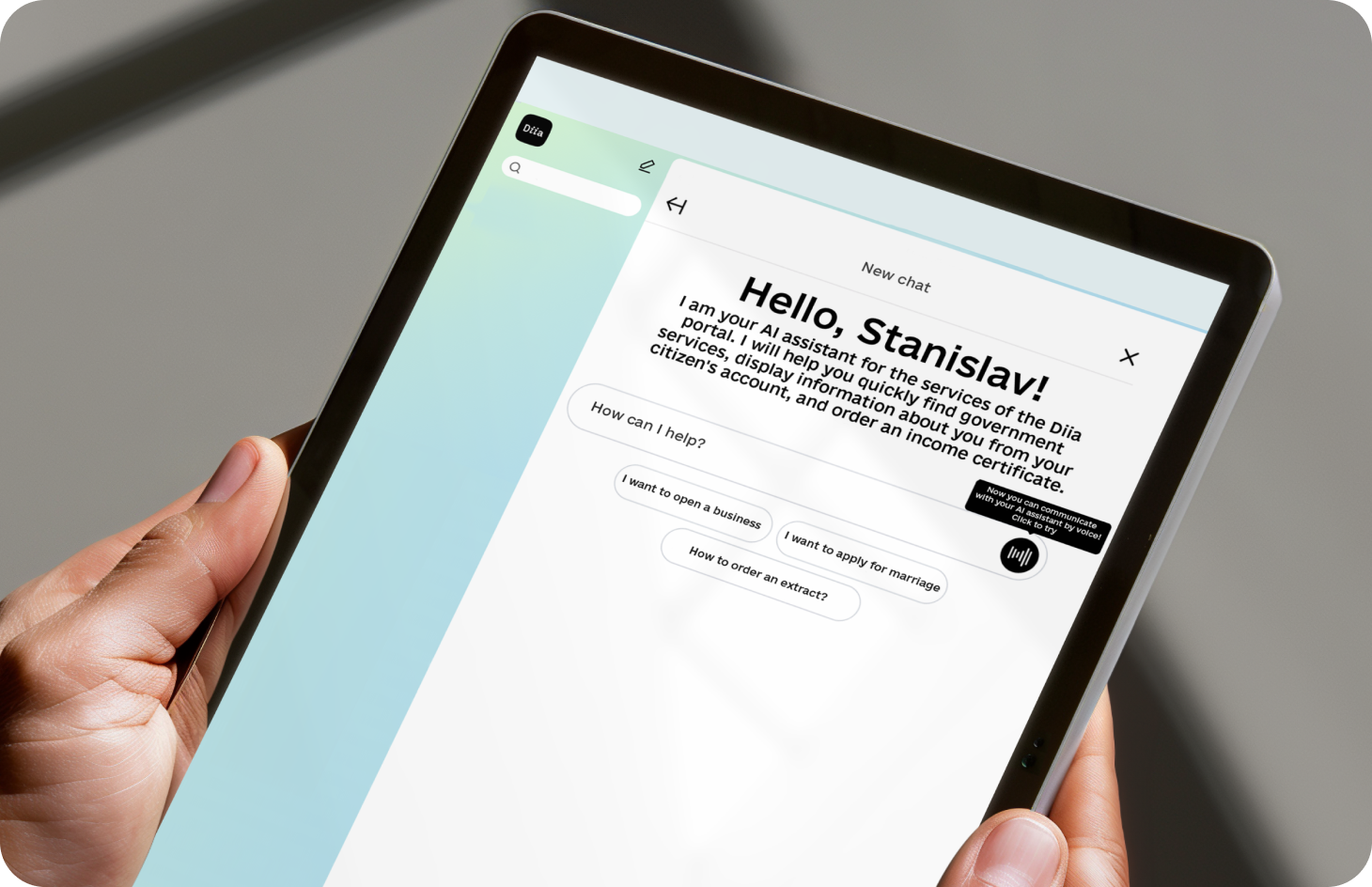
Voice interaction is now available in Diia.AI on the Diia portal, allowing people to communicate with the world's first government AI assistant using their voice.
The new functionality was developed by the Kitsoft team in collaboration with the Ministry of Digital Transformation of Ukraine. Users can now ask questions by voice, receive AI-generated responses, and seamlessly continue the same conversation using both voice and text.
Public Services Through Conversation
In September 2025, Ukraine launched Diia.AI – the world's first government AI assistant that not only provides information but also helps citizens access public services through natural conversation on the Diia portal.
Instead of searching through menus or filling out multiple forms, users can simply describe what they need in natural language. The assistant understands the request, answers questions, and, when applicable, helps initiate the required government service.
One of Diia.AI's key capabilities is completing public services within a single conversation. For example, users can already request an income certificate without manually searching for the service or filling out additional forms. The document is automatically generated within Diia and delivered to both the user's personal account and email.
The assistant also provides information about business registration status, tax group, real estate, land plots, pension records, insurance history, and more.
As additional government registries become connected, Diia.AI will continue expanding its capabilities from individual services to comprehensive life-event scenarios and fully integrated administrative processes.
From Text Chat to Voice Interaction
Initially, Diia.AI was available only as a text-based assistant. Users can now choose whether to communicate through text, voice, or a combination of both within the same conversation.
To start using voice mode, users simply tap the voice button, grant microphone permission, and begin speaking naturally. The assistant responds conversationally while preserving all the capabilities already available through the text chat.
"Today, people naturally interact with digital services through conversation. It has become the standard way to access information, solve everyday tasks, and use technology. Government services should evolve in the same direction. Voice interaction with Diia.AI makes communication with government simpler and closer to the digital experiences people already expect from modern technologies." – Oleksandr Yefremov, CEO of Kitsoft
What Kitsoft Developed
As part of the project, the Kitsoft team delivered:
The Diia.AI interface for the Diia portal;
Seamless voice and text interaction within a single conversation;
Microphone access flows and permission management;
Integration of the conversational interface with Diia services.
This enables users to switch freely between voice and text while maintaining one continuous conversation with the AI assistant.
Voice interaction marks the next stage in the evolution of Diia.AI. Previously, Kitsoft developed the technological foundation of the assistant using the Liquio low-code platform. This architecture now makes it possible to continuously expand Diia.AI with new capabilities and more advanced ways of interacting with public services.
International Recognition
Diia.AI has received significant international recognition for its innovation in digital government.
The Guinness World Records officially recognized Diia.AI as the world's first government AI assistant providing public services at the national level.
At the SEMIC Best Cases Awards 2025, the assistant won the Citizens Award, recognizing its value as an innovative digital public service.
In April 2026, the World Economic Forum featured Diia.AI in its global report Making Agentic AI Work for Government. After analyzing around 70 core government functions, from cybersecurity to social benefits the report selected only four real-world case studies worldwide demonstrating how agentic AI can transform public administration.
The report highlights Diia.AI as a new model of citizen-government interaction, enabling people to communicate with government services in natural language and access information and public services through a conversational interface.